
Menu
Have you ever caught your reflection and thought, “Why do I look so annoyed?” Maybe a friend has asked if you’re upset when you were just thinking. Or a coworker wondered if something was wrong when you were perfectly fine.
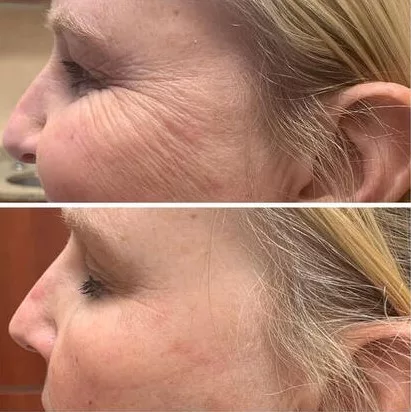 If that sounds familiar, the culprit is probably those vertical creases between your eyebrows. They’re so common they have a nickname: “the 11s.” The good news is that they’re one of the easiest wrinkles to treat. Botox and similar injectables like Dysport offer a fast, simple, and effective way to smooth out these frown lines and help you look as relaxed as you feel.
Let’s look at why these lines show up, how Botox works on them, and what you can expect from treatment.
The lines between your brows aren’t random. They come from muscle movement, and a lot of it.
Just above and between your eyes sits a group of three small muscles. Together they’re called the glabellar complex. Every time you frown, squint, concentrate, or react to bright sunlight, these muscles contract and pull your eyebrows down and inward.
Think about how many times a day that happens. Reading a screen, driving into the sun, focusing on a tough problem, reacting to bad news. Over months and years, that repeated folding leaves its mark on the skin. At first, the lines only appear when you make the expression. These are called dynamic wrinkles. With time, as skin loses collagen and elasticity, they can stay visible even when your face is at rest. These are static wrinkles.
That’s why the 11s often become more noticeable in our 30s and 40s, although people who squint a lot or spend plenty of time in the sun may notice them earlier.
Botox is a purified protein that temporarily blocks the nerve signals telling a muscle to contract. When the muscle can’t tighten, the skin above it stays smooth.
For frown lines, an experienced injector carefully places small amounts of Botox into each of the muscles in the glabellar complex. Once those muscles relax, they can no longer pull your brows together and crease the skin. The result is a softer, smoother area between your eyes.
It’s worth knowing that treating the glabellar lines is one of the most well-studied cosmetic uses of Botox. It’s a go-to treatment for this exact concern because the results are so reliable.
Here’s something many people don’t expect. When the glabellar muscles relax, they stop pulling your brows downward. That lets the forehead muscle, called the frontalis, do its job even better, which is lifting the eyebrows up.
So you don’t just get smoother skin between your eyes. You may also notice slightly higher, more open brows. Together, these changes can make you look happier, more rested, and more awake, without looking “done.”
You’ll often hear Botox and Dysport mentioned together, and for good reason. Both are neuromodulators made from botulinum toxin, and both are used to treat frown lines.
The main differences are small:
In practice, both deliver excellent results for the 11s. Your provider will recommend the best option based on your anatomy, goals, and past experience with injectables.
One of the best things about Botox for frown lines is how quick and easy it is.
Your provider will look at your facial movement, ask you to frown and raise your brows, and talk through your goals. This is the time to share any medical history, medications, or concerns.
The treatment itself usually takes about 10 to 15 minutes. A very fine needle is used, and most people describe the feeling as a quick pinch. Numbing cream or ice can be used if you’re sensitive.
There’s no real downtime. Many people head straight back to work or errands. You may see small bumps at the injection sites that fade within an hour, and minor redness or bruising is possible.
Your provider will likely suggest avoiding rubbing the area, lying flat, or heavy exercise for the rest of the day. These simple steps help the product stay where it was placed.
Botox doesn’t work overnight, but you won’t wait long. Most people start to notice their frown lines softening within 3 to 5 days. Full results usually appear around 10 to 14 days after treatment.
Results typically last about 3 to 4 months. As the effect gradually wears off, muscle movement returns and the lines slowly reappear. Many patients book regular maintenance appointments to keep their results consistent. Over time, some find their lines become less deep, since the muscles have been trained to relax.
Botox is a great option if you:
If your lines are very deep and visible even at rest, Botox can still soften them significantly. In some cases, your provider might suggest combining it with a dermal filler or skin treatment for the best result.
Botox isn’t recommended for people who are pregnant or breastfeeding, or those with certain neuromuscular conditions. A proper consultation with a qualified provider is always the first step.
Botox works best when paired with good daily habits:
Most people feel only a brief pinch. The needle is very fine and the whole process takes just a few minutes.
Yes. A skilled injector targets only the muscles that cause frown lines, so you can still smile, raise your brows, and express yourself naturally.
It varies by person, depending on muscle strength and anatomy. Your provider will determine the right dose during your consultation.
It can help. By limiting the repeated muscle movement that creates wrinkles, regular treatment may slow down the formation of deeper lines.
You shouldn’t have to explain to people that you’re not upset. If the lines between your eyes are making you look tired, stressed, or angry, Botox offers a simple and proven way to smooth them out. With a quick appointment and no real downtime, you can look as calm and refreshed as you feel.
Ready to soften your frown lines? Book a consultation with our experienced team and find out how Botox can help you look your best.