
Patients who want to get Botox for forehead wrinkle treatment need to know the exact number of units that will fulfill their treatment requirements. Medical experts receive this question as their most common patient inquiry, which appears before every consultation. Medical professionals need to determine the required Botox units for each patient because every individual needs a different amount of injections.
Medical professionals need to determine the proper Botox dosage for each patient based on their facial structure, muscle strength, wrinkle severity, and individual treatment goals and specific treatment regions. A skilled injector decides Botox unit amounts by observing your facial muscle movements to generate natural-looking results.
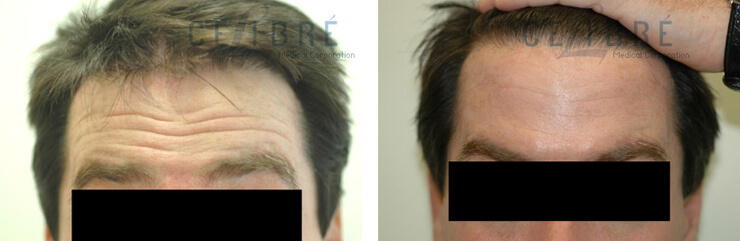
Celibre Medical offers Botox treatments that they personalize to reduce wrinkle visibility while delivering skin revitalization and preserving your face’s natural expression.
What Does Botox Do for Forehead Lines?
Botox functions as an injectable medical procedure that gives patients temporary muscle relaxation in specific facial areas that produce movement-based wrinkles. The lines form when you raise your eyebrows or when you frown or smile or perform any other facial movement.
Botox treatment for forehead wrinkles works by targeting the muscles that produce horizontal wrinkles that form in the upper facial area. When properly placed, Botox can help:
- Smooth forehead lines and wrinkles
- Create a more relaxed appearance
- Prevent existing wrinkles from becoming deeper
- Maintain natural facial movement
- Refresh the overall look of the upper face
However, successful Botox treatment depends on more than just the number of units used. The location of each injection is equally important.
How Many Units of Botox for Forehead Lines Are Usually Needed?
Doctors usually need to give between eight and twenty units of Botox to perform a typical forehead Botox treatment. The amount of Botox units required for each patient varies because their needs differ from person to person in our clinic.
Factors that influence the number of Botox units include:
- Strength of forehead muscles
- Depth of wrinkles
- Size of the treatment area
- Previous Botox history
- Desired level of movement after treatment
- Facial symmetry and anatomy
Someone with stronger forehead muscles or deeper lines may need additional units, while someone looking for subtle prevention may require fewer.
Why Forehead Botox Requires a Customized Approach
The frontalis muscle, which exists in the forehead, serves as the muscular system that enables eyebrow elevation. The wide muscle spans from the eyebrow area to the hairline region and produces horizontal forehead wrinkles when it tightens.
Because everyone moves their forehead differently, doctors need to create individual Botox treatment plans for each patient. The treatment requires different Botox injection amounts because some patients need their forehead center treated more than the outer regions.
A skilled Botox provider needs to perform injections because wrong injection techniques and excessive Botox doses will create fake-looking results.
Botox for the Glabella: Treating the Area Between the Eyebrows
When asking about the required Botox units for forehead wrinkle treatment, you need to know that patients often need treatment for their glabella area as well.
The glabella exists between the eyebrows where people develop frown lines, which others call “11 lines”. The muscles create downward eyebrow movement when you show concentration or frown.
The forehead treatment will disrupt muscle equilibrium because it fails to treat the glabella area. The process leads to eyebrow positions that become closer to the eyes and their weight seems to increase.
The typical Botox treatment for glabella area patients involves 20 units but doctors adjust this amount based on patient muscle activity and their desired treatment results.
Should Crow’s Feet Be Treated with Forehead Botox?
The medical procedure to treat crow’s feet does not need to occur for every patient who gets forehead Botox but practitioners often combine these treatments for better results.
The fine lines which appear at the outer eye corners become known as crow’s feet. People develop these lines because they continue to smile and squint their eyes while they move their faces.
Treating this area may help:
- Reduce wrinkles around the eyes
- Create a smoother upper-face appearance
- Provide a subtle lifting effect around the eyebrows
- Improve overall facial balance
A professional Botox injector evaluates all areas together rather than treating one wrinkle alone.
Why More Botox Units Are Not Always Better
Some people believe that using more Botox automatically creates better results, but that is not always true. The goal is to use the correct amount not necessarily the highest amount.
The treatment will not create long-lasting effects when practitioners use insufficient units because patients will return to their baseline state. The use of too many units results in restricted facial movements which produce artificial looking results.
A proper Botox treatment plan focuses on achieving:
- Balanced facial movement
- Natural-looking results
- Long-lasting improvement
- A refreshed appearance without looking overdone
How Long Does Forehead Botox Last?
Forehead Botox results commonly last around 3 to 4 months, although individual experiences can vary.
Several factors can affect how long Botox lasts, including:
- Metabolism
- Muscle activity
- Treatment dosage
- Lifestyle factors
- Consistency of Botox treatments
Regular maintenance appointments can help preserve smoother-looking skin over time.
Choosing the Right Injector for Forehead Botox
People should select their Botox provider based on how many years they have spent working in this industry. The injector who possesses expertise about facial anatomy understands how different muscle groups operate together.
A proper Botox treatment needs more than unit injections because it requires strategic planning together with exact injection positions and treatment plans which suit the individual patient.
Celibre Medical provides individualized Botox solutions which they base on their patients’ specific facial features and their desired appearance results.
Frequently Asked Questions About How Many Units of Botox for Forehead
How many units of Botox for forehead treatment do most people need?
Most patients need around 8 to 20 units of Botox for forehead lines. The exact number depends on muscle strength, wrinkles, and desired results.
Is 10 units of Botox enough for the forehead?
Ten units of Botox will show results for patients who have mild wrinkles and want to see subtle changes in their appearance. Others may require additional units.
Is 20 units of Botox a lot for the forehead?
Twenty units become the correct dosage for patients who show strong forehead muscle activity together with deep facial wrinkles. Your injector will determine the right amount during evaluation.
How quickly does forehead Botox start working?
Patients will see their first results after a few days and their body will reach its complete response after two weeks of treatment.
Can Botox make forehead wrinkles disappear completely?
Botox treatment helps patients achieve better forehead wrinkle appearance because it controls their muscle development. The healing process for severe facial wrinkles needs either continued monitoring or patients must get different treatment options to see results.
Final Thoughts
You need to establish your specific forehead Botox unit requirement by analyzing your individual face structure together with your treatment objectives. Most patients need around 8 to 20 units of Botox for forehead line treatment but doctors achieve optimal results through customized treatment plans.
A skilled Botox specialist assesses muscle patterns in patients to determine exact treatment amounts that produce natural-looking facial results by using precise injection methods.