
Acne clears up, but sometimes it leaves something behind: small dents and pits that don’t go away. These are depressed acne scars. They form when a deep breakout damages the tissue under the skin, and the skin heals a little lower than the area around it. So even years after your last breakout, the marks are still there in the mirror.
People often ask us which treatment is best for depressed acne scars. The honest answer is that it depends on your scars. Their type, their depth, and the way your skin heals all play a part. That’s why we always start with a proper look at your skin before suggesting anything.
What Are Depressed Acne Scars?
Depressed scars sit below the surface of the surrounding skin. Doctors also call them atrophic acne scars, because they form when the skin loses tissue as it heals. If you want the background, our guide on what causes acne scars explains it in more detail.
Not every depressed scar looks the same. You’ll usually see one or more of these:
- Boxcar scars: wide dents with sharp edges, almost like a small box pressed into the skin.
- Rolling scars: broad, shallow dips with soft edges. They make the skin look wavy, especially in side light.
- Ice pick scars: narrow, deep pits that look like tiny holes.
Some people have one or two scars. Others have whole areas of uneven skin, most often on the cheeks, temples, and forehead.
Why Are Depressed Acne Scars Hard to Treat?
There are two main reasons. First, the scars sit at different depths. Some are close to the surface, and others go much deeper. Second, many of them are tied down by bands of scar tissue underneath. Those bands pull the skin inward, which is why the scar looks sunken.
Because of this, one treatment rarely fixes everything. A shallow dent might smooth out nicely with a laser, while a deep, older scar on the same cheek may need something else. A good provider will look at each type of scar before making a plan.
Is Laser Resurfacing a Good Treatment for Depressed Acne Scars?
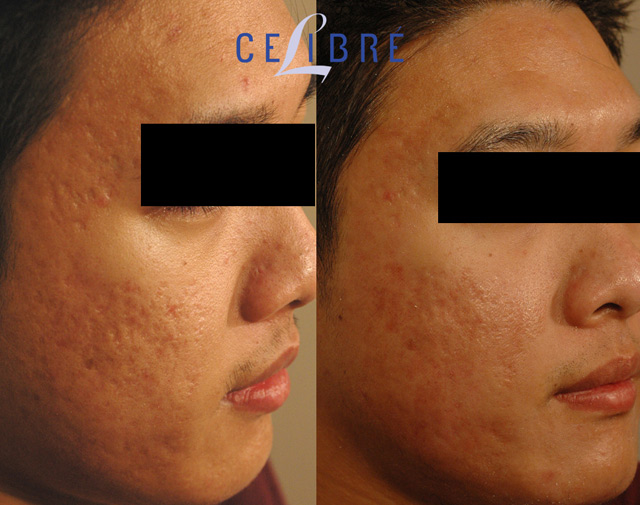
For a lot of people, yes. Laser resurfacing is one of the treatments we use most often for depressed acne scars. It removes thin layers of damaged skin and prompts your body to make new collagen. Over the following months, that new collagen helps lift and smooth the scarred areas.
Lasers come in two main types:
- Ablative lasers, like erbium laser resurfacing, remove the top layers of skin. They give stronger results, but you’ll need some time to heal.
- Non-ablative lasers heat the deeper skin and leave the surface intact. There’s little or no downtime. On the other hand, the results are milder, and researchers are still studying how long they last for acne scars.
Which one is right for you depends on how deep your scars are and on your skin type. If you’d like to see what’s possible, take a look at our acne scars before and after photos.
Other Treatments for Depressed Acne Scars
Lasers work well, but they aren’t the only option. For some scars, we combine them with other treatments:
- Subcision: a fine needle cuts the bands that pull rolling scars down, so the skin can lift.
- Dermal fillers: filler raises a sunken area right away. It works best for soft, rolling scars.
- Microneedling: tiny needles encourage collagen growth. It can help shallow scars over a few sessions.
- Punch excision: for deep scars that don’t respond to anything else. We explain it below.
How Do We Choose the Best Treatment for Your Depressed Acne Scars?
When we plan treatment, we look at:
- How deep and severe the scars are
- Their size and shape
- How much of the skin is scarred
- Your skin type
- Where the scars are
- Whether they’re shallow or deep
No two faces scar in exactly the same way, so the best plan for one person can look quite different from the next. Patients also want to know how many treatments they’ll need. The answer depends on the same points listed above.
When Is Punch Excision Used for Depressed Scars?
We usually save punch excision for deep, stubborn scars, like ice pick scars or deep boxcar scars. The provider uses a small round tool to remove the scar and then closes the skin with a stitch or two. In other words, a deep pit is swapped for a small, flat line that’s much harder to notice.
After the skin heals, we often follow up with laser resurfacing. That way the treated spot blends in with the rest of your skin.
Can You Treat Depressed Acne Scars at Home?
It’s natural to want an easy fix, and there are plenty of creams and tools that promise one. However, nothing you apply at home can rebuild the tissue that’s missing under a depressed scar. These scars change the deeper structure of the skin, so real improvement takes professional acne scar treatment.
That said, what you do at home still counts. Treating breakouts early and not picking at your skin can help you prevent new acne scars. The American Academy of Dermatology also suggests working with a board-certified dermatologist if you want to reduce acne scars.
FAQs About Depressed Acne Scars
Will depressed acne scars go away on their own?
No. These scars come from lost tissue, so they don’t fill back in by themselves. You’ll need treatment to improve them.
What works best for deep depressed acne scars?
Deep scars usually need more than one treatment. For example, we might use punch excision or subcision first and then laser resurfacing.
How many laser sessions will I need?
That depends on your scars. Some patients do well after one ablative treatment, while non-ablative lasers usually take several sessions.
Do fillers fix depressed scars permanently?
Most fillers aren’t permanent. They last from several months to over a year, so you’ll need touch-ups to keep the results.
Choosing the Right Treatment for Your Depressed Acne Scars
Start by knowing your options. Laser resurfacing works for many people, and punch excision, subcision, or filler can help with certain scars. Your best plan comes down to how severe the scars are and what kind of skin you have.
At Celibre Medical in Torrance, we check the type and depth of each scar, whether it’s new or years old, and then build a plan around your skin. If you’re ready to find out what will work for you, contact us to book a consultation.