
Many patients think of lasers as a “cure-all” for every skin concern. Laser technology has come a long way in recent years, but that idea simply isn’t true. Different lasers are built for different jobs, and if you don’t know what to look for, your results may fall short of what you hoped for.
At Celibré, we’re committed to helping you match the right laser to your specific skin condition. When it comes to age spots, choosing the best laser for age spots depends on what kind of pigment you’re dealing with and where it shows up on your skin.
What Are Age Spots?
Age spots, also called sun spots or liver spots, are flat brown, tan, or dark patches that appear on areas of the skin that get the most sun. They’re most common on the face, hands, shoulders, forearms, neck, and chest.
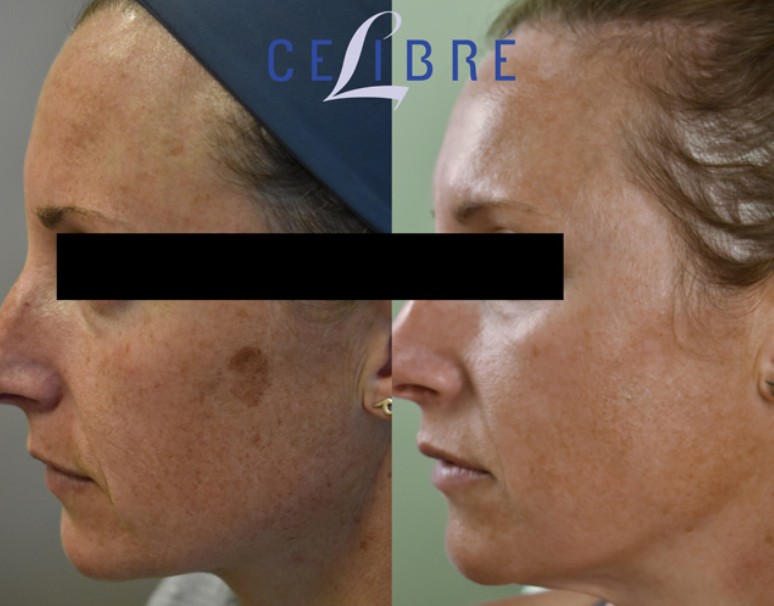
Despite the name, age spots aren’t really caused by aging itself. They’re caused by years of sun exposure. When UV rays hit your skin, your body produces extra melanin to protect itself. Over time, that pigment can collect in certain areas and form visible spots. Because sun damage builds up gradually, these spots usually start appearing in your 40s and 50s, although people who spend a lot of time outdoors can notice them much earlier.
Age spots are generally harmless, but many people want them removed because they can make skin look older, uneven, or tired. Any spot that changes in size, shape, or color should always be checked by a medical professional before treatment.
How Lasers Remove Age Spots
Lasers that target pigment are used to remove age spots. These lasers send light energy into the skin, where it’s absorbed by the dark pigment in the spot. The energy breaks the pigment into tiny particles, which your body then naturally clears away over the following days and weeks.
The surrounding skin, which has less pigment, is largely left alone. That’s what makes pigment-targeting lasers so effective for sun spots: they focus on the problem area without causing unnecessary damage to healthy skin.
At Celibré, we use two main technologies to treat sun-related pigment:
- Q-switched lasers to remove individual spots caused by sun exposure
- BBL (IPL) to remove or improve diffuse pigment, meaning general discoloration spread across a wider area
Each one plays a different role, and understanding the difference is the key to getting the results you want.
Q-Switched Lasers: Best for Individual Sun Spots
Q-switched lasers were originally designed to remove pigment such as tattoos and birthmarks. Compared to those, sun spots are usually very straightforward to treat.
These lasers deliver energy in extremely short, powerful pulses. That precision allows them to shatter concentrated pigment quickly and effectively. Because they’re so powerful, we usually use them only on the exact area where the sun spot appears, rather than across the entire face or body.
After treatment, the spot typically darkens for a short time before it flakes off and fades. For many patients, a single session makes a dramatic difference, though some deeper or darker spots may need a follow-up treatment.
If you have a few clearly defined brown spots on your face or hands, a Q-switched laser is often the best laser for age spots of this kind.
BBL (IPL): Best for Overall Discoloration
IPL, which stands for Intense Pulsed Light, works very differently. Instead of a single, focused wavelength, it uses a broad spectrum of light spread over a larger area. BBL (BroadBand Light) is an advanced form of this technology.
IPL often can’t fully remove round, well-defined age spots on its own. Where it really shines is in treating accumulated sun damage that causes uneven skin tone, especially on the forehead, neck, and chest. If your skin looks blotchy, freckled, or discolored overall rather than marked by a few distinct spots, IPL is usually the better choice.
Many patients also notice that their skin looks brighter and more even after a series of IPL sessions, since the treatment addresses the overall pattern of sun damage rather than one spot at a time.
Why the Two Work Best Together
Most people with sun damage don’t have just one type of pigment problem. They may have a few distinct age spots on their cheeks along with general discoloration across their face, neck, or chest.
That’s why using Q-switched lasers and IPL together makes such a powerful combination. The Q-switched laser targets the individual spots, while IPL evens out the surrounding skin tone. Together, these devices can help patients with sun damage get rid of most, or even all, of their discoloration.
During your consultation, we’ll look closely at your skin and decide which device, or which combination, fits your needs.
What to Expect After Treatment
Most laser treatments for age spots require little to no downtime. You may notice some redness or mild swelling for a few hours after treatment. Treated spots often turn darker before they fade, which is a normal sign that the pigment is being broken down and cleared.
Avoid picking or scrubbing the treated areas while they heal, and follow any aftercare instructions your provider gives you. Most people see noticeable improvement within a few weeks.
Prevention Is Still the Best Treatment
No matter which laser we use to treat your age spots, we always remind our patients that the best treatment is prevention.
Laser treatment can remove existing spots, but it can’t stop new ones from forming if your skin keeps getting sun damage. Always practice sun-smart habits: wear a hat outdoors, seek shade during peak hours, and use a broad-spectrum sunscreen every day that protects your skin from both UVA and UVB rays. Protecting your skin after treatment is the best way to keep your results looking clear for years to come.
Ready to find the best laser for your age spots?